
How to Choose the Right Welding Positioner Manufacturer
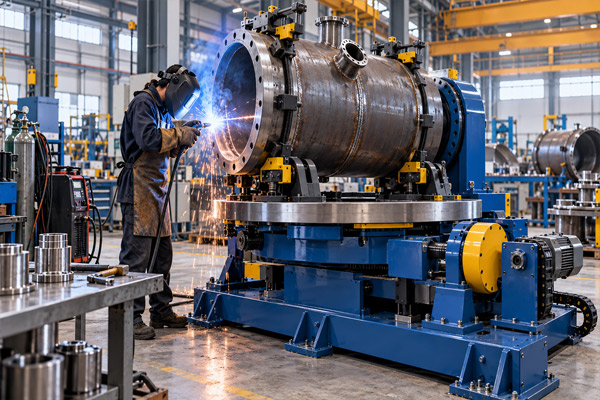
A reliable Welding Positioner Manufacturer helps fabrication companies improve welding accuracy, operator comfort, production speed, and repeatability. Welding positioners are used to rotate, tilt, or hold a job in the correct welding position so that the welder or automated welding torch can work more efficiently.
These machines are useful for components such as pipes, flanges, tanks, valves, pressure vessels, circular parts, structural assemblies, and heavy fabrication jobs.
Before selecting a welding positioner, buyers should check job weight, component diameter, rotation speed, tilt angle, welding process, clamping method, automation level, and production requirement.
What Is a Welding Positioner
A welding positioner is a machine used to hold and rotate a component during welding.
Its main purpose is to place the welding joint in a comfortable and stable position.
Depending on the machine design, a welding positioner may provide:
- 360 degree rotation
- Tilting
- Variable speed control
- Chuck or fixture mounting
- Motorized rotation
- Foot pedal control
- PLC control
- Automatic welding integration
This helps reduce manual handling and improve consistency.
Why Industries Use Welding Positioners
Welding positioners are useful because they improve control over the workpiece.
Main benefits include:
- Better weld accessibility
- Improved operator safety
- More consistent weld quality
- Faster welding cycles
- Reduced manual component handling
- Better positioning accuracy
- Lower operator fatigue
- Improved productivity
- Suitable for repetitive welding
- Easy integration with welding automation
For high-volume fabrication, these benefits can reduce production time and improve repeatability.
Applications of Welding Positioners
A professional Welding Positioner Manufacturer can develop machines for many industrial applications.
Pipe Welding
Pipe welding often requires smooth and continuous rotation.
A pipe welding positioner can help maintain a steady welding speed around the joint.
Flange Welding
Flanges can be mounted and rotated for easier circular welding.
This is useful in pipeline, valve, pump, and fabrication industries.
Tank Welding
Tanks and cylindrical components may require controlled rotation during circumferential welding.
Pressure Vessel Welding
Pressure vessel manufacturers may use welding positioners for shells, nozzles, flanges, and circular weld joints.
Valve Component Welding
Valve bodies and related components may require accurate positioning during welding.
Automobile Component Welding
Custom fixtures and positioners can be developed for repetitive automotive welding jobs.
Rotary Welding Positioner
A Rotary Welding Positioner rotates the workpiece at a controlled speed during welding.
It is useful for round or cylindrical components.
Common applications include:
- Pipes
- Flanges
- Rings
- Couplings
- Tanks
- Circular frames
- Valve components
Variable speed control helps the operator adjust rotation according to the welding process.
Automatic Welding Positioner
An Automatic Welding Positioner can be integrated with automated welding systems.
It may include:
- PLC control
- Servo motor
- VFD speed control
- Automatic clamping
- Welding torch synchronization
- Cycle control
- Safety interlocks
This type of system is useful for repetitive production where weld quality and cycle time must remain consistent.
What to Check Before Buying a Welding Positioner
Before requesting a quotation, buyers should provide technical information.
SPM Welding Positioner
An SPM Welding Positioner is designed for a specific industrial welding application.
SPM stands for Special Purpose Machine.
Instead of using a general-purpose positioner, an SPM machine can be customized according to:
- Component size
- Job weight
- Welding joint
- Fixture requirement
- Rotation speed
- Tilt angle
- Loading method
- Welding sequence
- Production quantity
This makes it suitable for OEMs and high-volume manufacturers.
Heavy Duty Welding Positioner
Heavy fabrication industries require positioners with strong frames, high load capacity, and stable rotation.
A Heavy Duty Welding Positioner may be used for:
- Large flanges
- Heavy pipe assemblies
- Pressure vessels
- Structural components
- Machine frames
- Industrial tanks
The machine structure should be selected according to actual load and center of gravity.
Welding Positioner vs Manual Welding Setup
| Welding Positioner | Manual Setup |
| Controlled workpiece rotation | Manual movement |
| Better repeatability | Operator dependent |
| Improved access | Limited access |
| Faster welding cycles | Slower repositioning |
| Suitable for automation | Mostly manual |
| Better ergonomics | Higher operator fatigue |
For repetitive welding applications, a welding positioner can improve workpiece control, reduce repositioning time and support more consistent production.
Welding Positioner for Pipe Fabrication
Pipe fabrication is one of the most common applications for welding positioners.
A pipe welding positioner can help maintain consistent rotation while the welding torch remains in a controlled position.
This can improve:
- Bead consistency
- Welding speed
- Joint accessibility
- Operator comfort
- Production repeatability
For automated welding, the positioner can be synchronized with the welding machine.
Welding Positioner for Flange Manufacturing
Flange welding requires stable circular positioning.
A customized positioner can help hold the flange and rotate it at the required speed.
Important inputs include:
- Flange diameter
- Flange weight
- Welding joint location
- Required speed
- Clamping type
- Production quantity
These details help in designing the correct fixture and drive system.
Custom Welding Fixtures
A welding positioner works best when the component is held properly.
Custom welding fixtures can help improve:
Fixtures may use:
How PCD Drilling Machines Improve Production
A PCD drilling machine can improve productivity by reducing manual steps.
Traditional processes may require:
- Measuring the PCD
- Marking each hole
- Center punching
- Positioning the component
- Drilling each hole manually
An automated PCD drilling machine can combine much of this work into one controlled cycle.
This can reduce:
- Setup time
- Human error
- Rework
- Production variation
Operator fatigue
PCD Drilling Machine Manufacturer in Ahmedabad
Ahmedabad has a strong engineering and machine manufacturing industry.
A PCD Drilling Machine Manufacturer in Ahmedabad can support manufacturers involved in automobiles, valves, pumps, flanges, transmission components, hydraulics, fabrication, and general engineering.
Local manufacturing support can also make it easier to discuss:
- Component drawings
- Machine layout
- Fixtures
- Trial components
- Automation requirements
- Installation
- Service support
Welding Automation with Positioners
A welding positioner can be integrated with other automation equipment.
Possible systems include:
- Welding torch manipulators
- Robotic welding systems
- Seam tracking
- PLC control
- Automatic clamping
- Safety enclosures
This can help create a complete welding automation cell.
Welding Positioner Manufacturer in Ahmedabad
Ahmedabad has a strong engineering, fabrication, automotive, machine building, and industrial manufacturing base.
A Welding Positioner Manufacturer in Ahmedabad can support industries with custom positioners, SPM welding machines, rotary tables, and automated welding solutions.
Local manufacturers can also provide support for:
- Component trials
- Fixture development
- Machine design
- Installation
- Commissioning
- Service
Welding Positioner Manufacturer in Gujarat
Industrial areas in Gujarat such as Ahmedabad, Sanand, Vadodara, Rajkot, Surat, Bharuch, Ankleshwar, Vapi, and Dahej have strong demand for fabrication and welding automation equipment.
A Welding Positioner Manufacturer in Gujarat can serve industries including:
- Automobile
- Valve manufacturing
- Pump manufacturing
- Pipeline
- Pressure vessel
- Heavy engineering
- Structural fabrication
- Chemical equipment
How to Choose the Right Welding Positioner Manufacturer
Choose a manufacturer that can study your component and process.
Conclusion
Choosing the right Welding Positioner Manufacturer can help improve weld quality, productivity, safety, and consistency.
The machine should be selected according to component weight, diameter, center of gravity, rotation speed, tilt angle, welding process, fixture design, and automation requirement.
For pipe, flange, tank, valve, pressure vessel, automobile, and heavy fabrication applications, a properly designed welding positioner can reduce manual handling and improve production efficiency.
Laxmi Technocrat can develop application-specific welding positioners and SPM solutions according to job drawings and production requirements.
Frequently Asked Questions
A welding positioner is a machine used to rotate or tilt a workpiece during welding so that the joint can be positioned in a more suitable and stable location.
An SPM Welding Positioner is a special-purpose machine designed for a specific component, welding process, load, fixture, and production requirement.
A rotary welding positioner is commonly used for circular components such as pipes, flanges, tanks, rings, and valve parts.
Yes. It can be customized according to job weight, table size, diameter, rotation speed, tilt angle, fixture design, and automation level.
Capacity should be selected based on job weight, fixture weight, center of gravity, distance from the table, and operating position.
Yes. Welding positioners can be integrated with PLC systems, welding torches, robots, servo controls, and automatic clamping.
Choose a manufacturer with experience in load calculation, fixture design, SPM development, automation, machine structure, testing, installation, and service support.